MEASURE · DIVIDE · MARK
How to space curtain ring centres evenly.
The marking distance is measured across the finished fabric laid flat. It is not the width of the curtain when hanging, and it is not the width of the rail.
Open the ring spacing calculator →
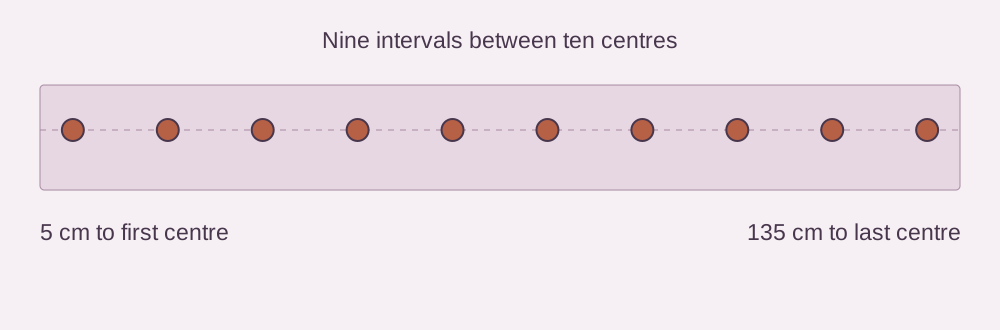
Start with the two outermost centres
Call the flat finished panel width W, and the equal centre inset at each end I. The first ring centre is I from the left edge. The last is W − I from the same edge. The distance between those centres is S = W − 2I. Both insets together must be less than the width.
An inset is measured to the centre of the hardware, not its outer edge. The appropriate inset and ring count depend on your actual hardware and curtain plan; this tool does not choose them or determine whether a centre is physically usable.
If you already know the number of rings
With N rings there are N − 1 intervals between centres. This is why dividing the span by N would give the wrong answer.
Equal centre spacing d = S ÷ (N − 1)
Position of ring j = I + (j − 1) × d
For an illustrative 140 cm panel with 5 cm inset at each end and eight rings, S = 130 cm. Seven intervals give d = 130 ÷ 7 = approximately 18.571 cm. The first centre is at 5 cm; the last is at 135 cm. Two identical panels use sixteen rings in total.
If you choose a maximum centre spacing
Call your chosen maximum M. Divide the centre span by M and round the number of intervals up. Add one to get the number of rings. The tool uses a small numeric tolerance at exact decimal boundaries so floating-point representation does not add an accidental extra interval.
Rings N = K + 1
Actual centre spacing d = S ÷ K
Using the same 140 cm panel and 5 cm insets, suppose you enter 15 cm as an illustrative maximum. The span is 130 cm. Dividing by 15 gives 8.667 intervals, so use nine intervals and ten rings. Actual spacing is approximately 14.444 cm. Two identical panels need twenty rings. The example does not recommend those measurements for a particular product.
| Ring | From left finished edge (cm) |
|---|---|
| 1 | 5.000 |
| 2 | 19.444 |
| 3 | 33.889 |
| 4 | 48.333 |
| 5 | 62.778 |
| 6 | 77.222 |
| 7 | 91.667 |
| 8 | 106.111 |
| 9 | 120.556 |
| 10 | 135.000 |
Check the full width
The left inset, all the equal intervals and the right inset must add back to the panel width. For the ten-ring example: 5 + (9 × 130/9) + 5 = 140 cm. Use the full-precision interval in this check, not a repeatedly rounded display value.
Use metric or inch measurements consistently
The calculator accepts mm, cm, m and inches. Switching units converts entered measurements. As a second exact arithmetic example, a 60 inch flat panel with a 2 inch inset at each end has a 56 inch centre span. A chosen maximum of 8 inches gives seven intervals and eight rings. This is a separate illustrative plan.
Print, download or save your inputs
The position list always measures from the same finished left edge. Print the plan or download its text list before marking. “Get plan link” creates a URL containing your current measurement inputs so you can reopen the same calculation; anyone with that link can read those measurements.
What this calculation leaves to your curtain plan
- Hung fullness, pleats, folds and how the fabric behaves between rings.
- Hardware dimensions, eyelet-hole diameter, clip suitability and load.
- Changes caused by unfinished hems, seams, patterned fabric or unequal insets.
- Panels with different widths or insets: calculate each distinct layout separately.
Use the finished flat width you intend to mark. Check your actual hardware instructions before transferring any positions to fabric. For shopping quantities, use the curtain fabric and panel calculator and its planning guide.
All dimensions in these examples are illustrative. Updated 15 October 2026. The formulas are derived from dividing a line segment into equal intervals; they are not hardware installation instructions.